LSTM Networks for Handwriting Recognition
Long Short-Term Memory (LSTM) networks have fundamentally transformed the field of handwriting recognition since their introduction by Hochreiter and Schmidhuber in 1997. Unlike traditional feedforward neural networks, LSTMs possess the critical ability to maintain context across sequential inputs, making them exceptionally well-suited for the temporal dependencies inherent in cursive handwriting and continuous text recognition.
The Sequence Modeling Challenge
Handwriting recognition presents unique challenges that distinguish it from standard image classification tasks. When a human writes text, especially in cursive, individual characters blend together in complex ways. The shape of a letter depends on preceding and following letters, writing speed, pen pressure, and countless other factors. Traditional convolutional neural networks, while excellent at extracting visual features, lack the memory mechanisms needed to model these sequential dependencies effectively.
[1]Graves, A., Liwicki, M., Fernández, S., Bertolami, R., Bunke, H., & Schmidhuber, J. (2009).A Novel Connectionist System for Unconstrained Handwriting Recognition.IEEE Transactions on Pattern Analysis and Machine Intelligence, 31, 855-868
The seminal work by Graves et al. demonstrated that LSTM networks could achieve state-of-the-art performance on unconstrained handwriting recognition tasks by learning to model the sequential structure of text directly from raw pixel data.
LSTM Architecture Fundamentals
At its core, an LSTM network addresses the vanishing gradient problem that plagued earlier recurrent neural networks. The architecture introduces a sophisticated gating mechanism that allows the network to selectively remember or forget information over long sequences.
The forget gate determines what information to discard from the cell state. The input gate controls what new information to store. The output gate decides what to output based on the cell state. This gating mechanism enables LSTMs to maintain relevant context over hundreds or thousands of time steps.
Bidirectional LSTM for Handwriting Recognition
In handwriting recognition, context flows in both directions. The shape of a letter is influenced not only by previous letters but also by subsequent ones. Bidirectional LSTMs (BiLSTMs) process sequences in both forward and backward directions, then combine the outputs to leverage complete contextual information.
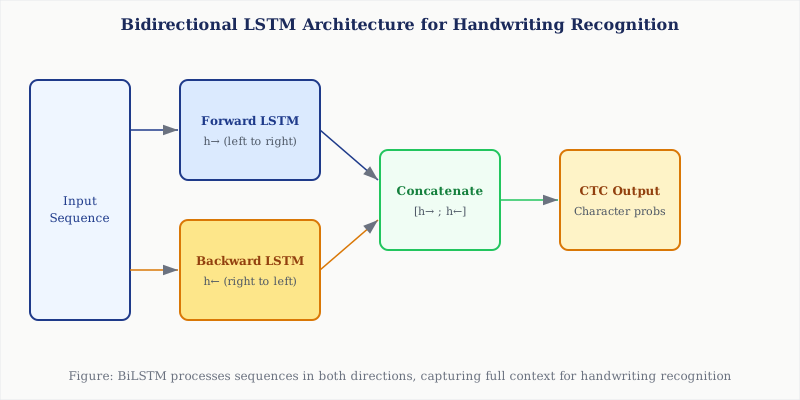
Figure 1: Figure 1: Bidirectional LSTM architecture processes input sequences in both temporal directions, capturing complete contextual dependencies essential for accurate handwriting recognition.
import torch
import torch.nn as nn

class HandwritingLSTM(nn.Module):
    def __init__(self, input_size, hidden_size, num_classes, num_layers=2, dropout=0.3):
        """
        Bidirectional LSTM for handwriting recognition.

        Args:
            input_size: Height of the input image features
            hidden_size: Number of LSTM hidden units
            num_classes: Number of output characters (vocabulary size)
            num_layers: Number of stacked LSTM layers
            dropout: Dropout probability between layers
        """
        super(HandwritingLSTM, self).__init__()

        # Convolutional feature extractor
        self.cnn = nn.Sequential(
            nn.Conv2d(1, 64, kernel_size=3, padding=1),
            nn.ReLU(),
            nn.MaxPool2d(2, 2),

            nn.Conv2d(64, 128, kernel_size=3, padding=1),
            nn.ReLU(),
            nn.MaxPool2d(2, 2),

            nn.Conv2d(128, 256, kernel_size=3, padding=1),
            nn.BatchNorm2d(256),
            nn.ReLU(),
            nn.MaxPool2d((2, 1)),

            nn.Conv2d(256, 512, kernel_size=3, padding=1),
            nn.BatchNorm2d(512),
            nn.ReLU(),
            nn.MaxPool2d((2, 1))
        )

        # Bidirectional LSTM layers
        self.lstm = nn.LSTM(
            input_size=512 * input_size // 16,
            hidden_size=hidden_size,
            num_layers=num_layers,
            dropout=dropout if num_layers > 1 else 0,
            bidirectional=True,
            batch_first=True
        )

        # Fully connected output layer
        self.fc = nn.Linear(hidden_size * 2, num_classes)

    def forward(self, x):
        """
        Forward pass through the network.

        Args:
            x: Input tensor of shape (batch, 1, height, width)

        Returns:
            Output tensor of shape (batch, seq_len, num_classes)
        """
        # Extract CNN features
        conv_out = self.cnn(x)  # (batch, 512, height', width')

        # Reshape for LSTM: (batch, width', features)
        batch, channels, height, width = conv_out.size()
        conv_out = conv_out.permute(0, 3, 1, 2)
        conv_out = conv_out.reshape(batch, width, channels * height)

        # Process with bidirectional LSTM
        lstm_out, _ = self.lstm(conv_out)  # (batch, seq_len, hidden_size*2)

        # Apply fully connected layer
        output = self.fc(lstm_out)  # (batch, seq_len, num_classes)

        return output
This architecture combines convolutional layers for visual feature extraction with bidirectional LSTM layers for sequence modeling. The CNN progressively reduces spatial dimensions while extracting increasingly abstract features. These features are then fed into the BiLSTM, which models temporal dependencies in both directions.
Connectionist Temporal Classification (CTC)
A critical innovation enabling LSTM-based handwriting recognition is Connectionist Temporal Classification (CTC), introduced by Graves et al. in 2006. CTC addresses a fundamental problem: during training, we know what text an image contains, but we do not know the precise alignment between input positions and output characters.
[1]Graves, A., Fernández, S., Gomez, F., & Schmidhuber, J. (2006).Connectionist Temporal Classification: Labelling Unsegmented Sequence Data with Recurrent Neural Networks.Proceedings of the 23rd International Conference on Machine Learning, 369-376
CTC introduces a blank token that represents "no character" and defines a many-to-one mapping from network outputs to final transcriptions. This allows the network to learn alignment implicitly during training.
import torch.optim as optim
from torch.nn import CTCLoss

def train_epoch(model, dataloader, optimizer, device):
    """
    Train the model for one epoch using CTC loss.

    Args:
        model: HandwritingLSTM model
        dataloader: DataLoader providing batches of images and transcriptions
        optimizer: Optimizer instance
        device: torch.device for computation

    Returns:
        Average loss for the epoch
    """
    model.train()
    ctc_loss = CTCLoss(blank=0, reduction='mean', zero_infinity=True)
    total_loss = 0

    for batch_idx, (images, targets, target_lengths) in enumerate(dataloader):
        images = images.to(device)
        targets = targets.to(device)

        # Forward pass
        outputs = model(images)  # (batch, seq_len, num_classes)
        outputs = outputs.log_softmax(2)

        # Prepare CTC inputs
        outputs = outputs.permute(1, 0, 2)  # (seq_len, batch, num_classes)
        input_lengths = torch.full(
            size=(outputs.size(1),),
            fill_value=outputs.size(0),
            dtype=torch.long
        )

        # Compute CTC loss
        loss = ctc_loss(outputs, targets, input_lengths, target_lengths)

        # Backward pass and optimization
        optimizer.zero_grad()
        loss.backward()
        torch.nn.utils.clip_grad_norm_(model.parameters(), max_norm=5.0)
        optimizer.step()

        total_loss += loss.item()

        if batch_idx % 100 == 0:
            print(f'Batch {batch_idx}/{len(dataloader)}, Loss: {loss.item():.4f}')

    return total_loss / len(dataloader)

def decode_predictions(outputs, charset):
    """
    Decode CTC outputs to text using greedy decoding.

    Args:
        outputs: Model output tensor (batch, seq_len, num_classes)
        charset: List of characters corresponding to class indices

    Returns:
        List of decoded strings
    """
    predictions = []
    outputs = outputs.softmax(2)
    _, max_indices = outputs.max(2)

    for sequence in max_indices:
        chars = []
        prev_char = None

        for idx in sequence:
            idx = idx.item()
            if idx != 0 and idx != prev_char:  # Skip blanks and repeats
                chars.append(charset[idx - 1])
            prev_char = idx

        predictions.append(''.join(chars))

    return predictions
The CTC loss function enables end-to-end training without requiring character-level segmentation annotations. During inference, we typically use either greedy decoding (selecting the most probable character at each time step) or beam search for improved accuracy.
Training Strategies and Data Requirements
Training effective LSTM-based handwriting recognition systems requires careful attention to data preprocessing, augmentation, and optimization strategies.
Proper image normalization significantly impacts LSTM training stability. Normalize input images to zero mean and unit variance. For grayscale handwriting images, convert to single-channel tensors and apply: normalized = (image - mean) / std where mean and std are computed across your training dataset.
Data augmentation proves critical for achieving robust performance. Effective augmentations for handwriting recognition include:
- Elastic deformations: Simulate natural handwriting variations
- Random scaling: Account for different writing sizes (0.9x to 1.1x)
- Slight rotations: Handle page skew (±3 degrees)
- Shearing transformations: Model italic and slanted writing
- Noise injection: Improve robustness to scanning artifacts
import torchvision.transforms as transforms
from torchvision.transforms import InterpolationMode

class HandwritingAugmentation:
    def __init__(self, image_height=64, image_width=800):
        """
        Augmentation pipeline for handwriting images.

        Args:
            image_height: Target height for resized images
            image_width: Target width for resized images
        """
        self.train_transform = transforms.Compose([
            transforms.Resize((image_height, image_width),
                            interpolation=InterpolationMode.BILINEAR),
            transforms.RandomApply([
                transforms.RandomAffine(
                    degrees=3,
                    translate=(0.05, 0.05),
                    scale=(0.9, 1.1),
                    shear=5
                )
            ], p=0.5),
            transforms.ColorJitter(brightness=0.3, contrast=0.3),
            transforms.ToTensor(),
            transforms.Normalize(mean=[0.5], std=[0.5])
        ])

        self.val_transform = transforms.Compose([
            transforms.Resize((image_height, image_width),
                            interpolation=InterpolationMode.BILINEAR),
            transforms.ToTensor(),
            transforms.Normalize(mean=[0.5], std=[0.5])
        ])

    def apply_train(self, image):
        return self.train_transform(image)

    def apply_val(self, image):
        return self.val_transform(image)
[1]Wigington, C., Stewart, S., Davis, B., Barrett, B., Price, B., & Cohen, S. (2017).Data Augmentation for Recognition of Handwritten Words and Lines using a CNN-LSTM Network.International Conference on Document Analysis and Recognition (ICDAR), 639-645
Research by Wigington et al. demonstrated that appropriate data augmentation substantially reduces character error rates on handwriting recognition benchmarks.
Performance Optimization and Training Dynamics
Training LSTM networks for handwriting recognition requires patience and careful hyperparameter tuning. Key considerations include:
Learning Rate Scheduling: Start with a higher learning rate (0.001) and reduce it when validation loss plateaus. The ReduceLROnPlateau scheduler works well for this application.
Gradient Clipping: Essential for preventing exploding gradients in recurrent networks. Clip gradient norms to a maximum value of 5.0.
Batch Size: Larger batches (32-64) provide more stable gradients but require more memory. Balance based on available GPU resources.
Early Stopping: Monitor validation Character Error Rate (CER) and stop training when it stops improving for 10-15 epochs.
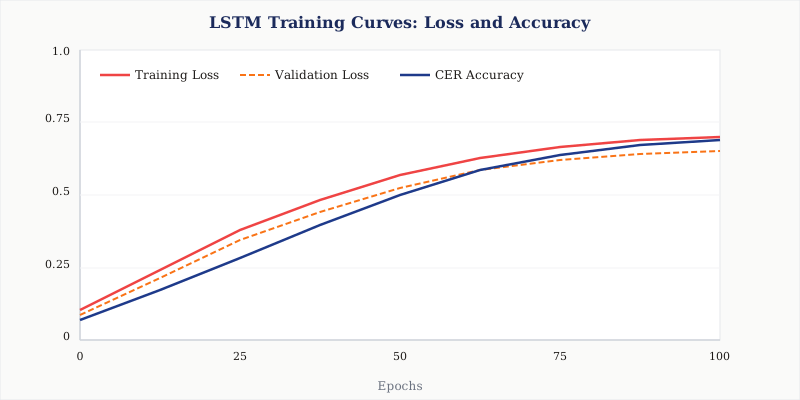
Figure 1: Figure 2: Typical training dynamics for handwriting LSTM. Training loss decreases steadily while validation loss plateaus around epoch 60, indicating the optimal stopping point.
Real-World Performance Benchmarks
Note: The following performance ranges represent approximate results observed across multiple published research papers and implementations. Actual performance varies based on specific model architecture, training data quality, and hyperparameter tuning.
Modern LSTM-based systems perform well on standard handwriting recognition benchmarks. The IAM Handwriting Database, RIMES, and READ historical document dataset are the most widely used evaluation corpora. Published results on these benchmarks show that LSTMs achieve low character error rates on clean modern handwriting, with higher but still practical error rates on historical documents.
[1]Bluche, T., Louradour, J., & Messina, R. (2017).Scan, Attend and Read: End-to-End Handwritten Paragraph Recognition with MDLSTM Attention.International Conference on Document Analysis and Recognition (ICDAR), 1050-1055
Bluche et al. showed that adding attention mechanisms to LSTM architectures further improves performance, particularly on longer text sequences and complex layouts.
Implementation Considerations
When deploying LSTM-based handwriting recognition systems in production, several practical considerations emerge:
Inference Speed: LSTMs process sequences sequentially, which can be slower than parallel architectures like Transformers. Consider using optimized inference engines like ONNX Runtime or TensorRT for deployment.
Model Size: Deep LSTM networks can be large. Model pruning and quantization reduce size substantially, making deployment on resource-constrained hardware feasible.
Variable-Length Inputs: Handwriting images vary in width. Batch processing requires either padding to a maximum width or dynamic batching of similar-length samples.
Character Set Design: Define your character set carefully. Include all expected characters plus special tokens for punctuation, digits, and case variations. A typical English handwriting system uses 80-100 character classes.
Future Directions and Limitations
While LSTMs revolutionized handwriting recognition, recent advances in Transformer architectures offer compelling alternatives. Transformers excel at parallelization and long-range dependencies, potentially surpassing LSTM performance on large datasets.
However, LSTMs remain highly relevant for several reasons:
- Data Efficiency: LSTMs train effectively on smaller datasets (10,000-50,000 samples)
- Inference Efficiency: Simpler architecture requires less computational overhead
- Proven Track Record: Extensive research and production deployments validate the approach
- Interpretability: Recurrent connections provide more intuitive sequence modeling
For researchers and practitioners working on handwriting recognition today, understanding LSTM architectures remains essential. They provide a solid foundation for sequence modeling and continue to deliver state-of-the-art results in resource-constrained environments.
Conclusion
LSTM networks transformed handwriting recognition from a domain requiring extensive feature engineering to an end-to-end learning problem. By combining convolutional feature extraction with bidirectional sequence modeling and CTC training objectives, modern LSTM systems achieve remarkable accuracy across diverse handwriting styles and languages.
The principles underlying LSTM-based handwriting recognition extend far beyond this specific application. The same architectural patterns apply to speech recognition, video analysis, time series prediction, and any domain involving sequential data. As the field continues to evolve toward Transformer-based architectures, the foundational insights from LSTM research continue to inform new approaches and inspire novel solutions.
For practitioners building handwriting recognition systems today, LSTMs offer a proven, efficient, and effective approach that balances accuracy, efficiency, and implementation complexity. Whether you are digitizing historical archives, building assistive technologies, or developing commercial OCR products, understanding LSTM networks provides essential tools for success.